Our Vision
Accelerating humanity into its next frontier.
We wonder, We build.
Mission
Starborne is building the hardware layer of the next space age, the infrastructure that makes it possible for humans to design, build and operate systems in any environment beyond Earth’s surface, starting with next-generation aerospace vehicles and lunar infrastructure.
We close the gap between what extreme-environment materials can physically achieve and what today’s manufacturing actually delivers, using embedded Physical AI process intelligence as our core capability.
What we are doing
The next space age will be built out of materials at their limit.
Launch is no longer the bottleneck. Reusable rockets made getting to orbit routine, and the constraint quietly moved somewhere less visible, into the hardware itself and whether it can be built to survive where it is going.
Every infrastructure era has had a materials problem underneath it. The railroads did not run on ambition, they ran on steel, and the same steel went into the rails, the bridges, the pipelines and the terminals. Whoever solved steel set the pace for everyone building on top of it.
Space has reached that point, and the problem shows up in places that look unrelated to each other. A vehicle holding Mach 10 through the atmosphere. A structure in very low Earth orbit, where atomic oxygen quietly eats anything conventional. A lunar surface that swings three hundred degrees between day and night. A capsule coming back from the Moon faster than any commercial vehicle has flown. Four industries on paper, and one engineering problem underneath.
Starborne is building the hardware for those environments, and the manufacturing capability that makes it possible.
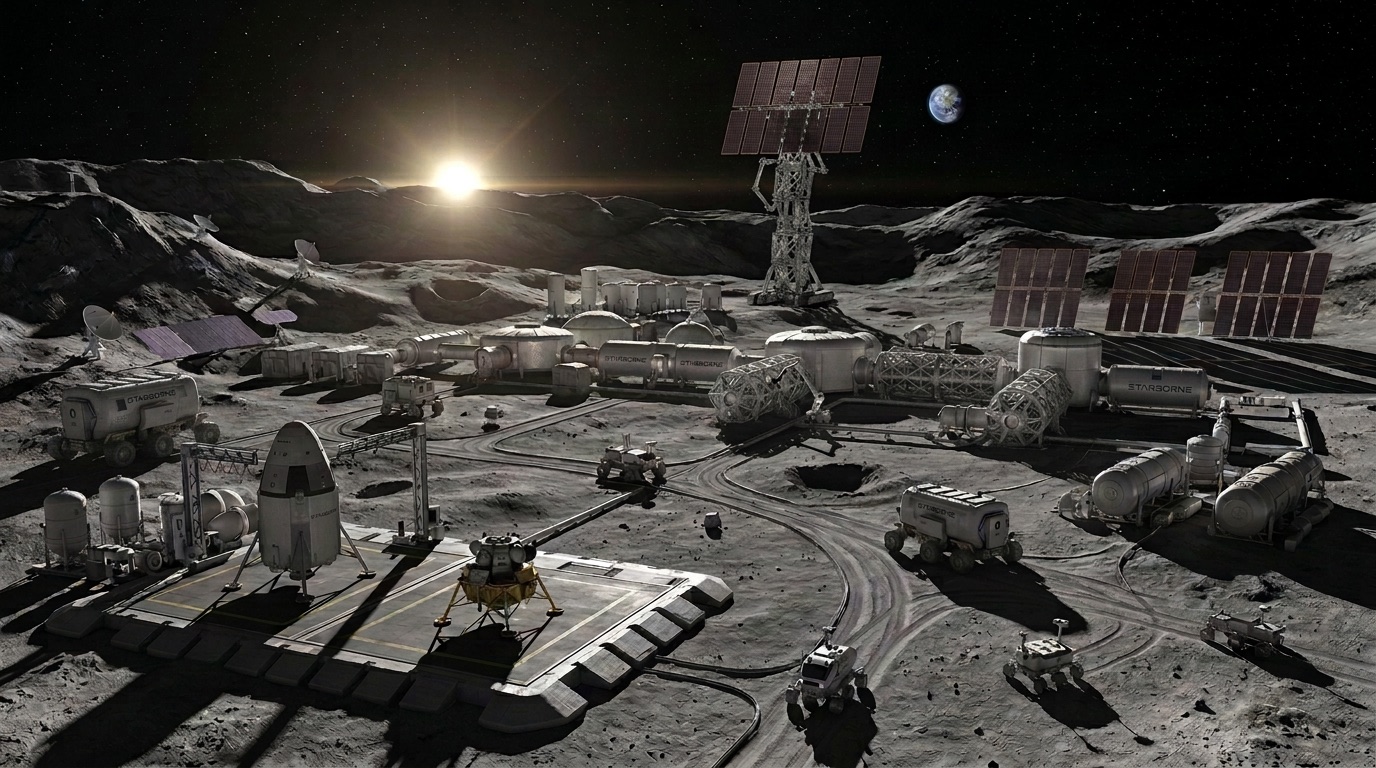 Where the constraint lives
Founder
Suyash Tandon, PhD
Founder and Chief Executive Officer
Suyash Tandon trained as a production engineer before he trained as a scientist. His undergraduate work put an FMEA programme into a live production line and lifted daily output by forty percent, and he spent the decade afterwards travelling in the opposite direction, from the factory floor into the models that describe it. A PhD at the University of Michigan in mechanical engineering and scientific computing took him deep into fluid mechanics and computational fluid dynamics, and from there into exascale GPU work at AMD.
The years since have been spent building hardware for environments that do not forgive. At Blue Origin he led the thermal and fluid systems on a $35M NASA lunar reactor programme and carried it through critical design review. At Reditus Space he was chief engineer for hypersonic reentry vehicles, building the programme from scratch. He now leads re-entry and demise engineering at Amazon Leo. Across various experiences, Suyash has lived the design-to-build gap.
Get in touch
Start a conversation
We are actively talking with defense and civil space program offices, prime contractors, university research groups, and investors working on long-horizon hardware.